media
Supported since API_LEVEL
3.0. For API compatibility, please refer to API_LEVEL.
The Media multimedia module includes a player and recorder with the capability to record and play audio.
create
Creates a multimedia control object
Pass the creation type to create a Player object or a Record object
create(id: number): Player | Record
| id Value | Description |
|---|---|
id.PLAYER | Player |
id.RECORDER | Recorder |
import { create, id } from '@zos/media'

const player = create(id.PLAYER)
Common Methods and Properties
Player and Record have common methods and properties
start
Starts playing/recording
start(): void
stop
Stops playing/recording
stop(): void
addEventListener
Event listening for player/recorder state monitoring. When the state changes, the callback function will be triggered
addEventListener(callback: function): void
Player Interface
setSource
Sets playback parameters and specifies the audio file path before starting playback
setSource(source: number, obj: object): void
The source value supports player.source.FILE
player.source.FILE plays a specified file, supporting MP3 format and OPUS format recorded using the audio API. The corresponding obj parameter type is as follows
| Property | Description | Required | Type |
|---|---|---|---|
| file | File path, relative to the mini app assets directory by default. Can use data:// to point to the mini app data directory to play downloaded audio files | Yes | string |
prepare
The player enters the preparation phase, checking if the path is correct, if the file format is playable, and if the bitrate is supported. If successful, the player state changes and starts caching multimedia data. Get the call result through the event listener function.
prepare(): void
import { create, id } from '@zos/media'

const player = create(id.PLAYER)

player.addEventListener(player.event.PREPARE, function (result) {
  if (result) {
    console.log('=== prepare succeed ===')
    player.start()
  } else {
    console.log('=== prepare fail ===')
  }
})
getDuration
Gets the total duration of the currently playing media file in seconds. Returns 0 to indicate invalid. The player must be in PREPARED state to get the value
getDuration(): number
getVolume
Gets the current system volume value, range [0 - 100]
getVolume(): number
setVolume
Sets the system volume value, range [0 - 100]. The result indicates whether the setting was successful, true indicates success
setVolume(vol: number): boolean
getTitle
Gets the title of the currently playing media file. Returns undefined on failure
getTitle(): string | undefined
getArtist
Gets the artist information of the currently playing media file. Returns undefined on failure
getArtist(): string | undefined
getMediaInfo
Gets the title, artist, and duration information of the currently playing media file
getMediaInfo(): MediaInfo
| Property | Description | Type |
|---|---|---|
| title | File name, available after setSource() | string|undefined |
| artist | Artist, available after setSource() | string|undefined |
| duration | File duration, player must be in PREPARED state to get the value | number |
release
Interface deprecated, no need to call manually, system automatically manages
Releases player hardware resources after playback stops
release(): void
getStatus
Gets the player state
getStatus(): number
Refer to player.state for the meaning of return values
seek
API_LEVEL
4.2
Sets the playback position (percentage position of playback file duration), percentage valid value [0 - 100]. The return value indicates whether the setting was successful.
- If currently in
PREPAREDstate, it will automatically start playing afterseek() - If currently in
PAUSEDorPLAYstate, it will maintain the current state afterseek()
seek(percentage: number): boolean
player.event
Event types supported by the player for listening
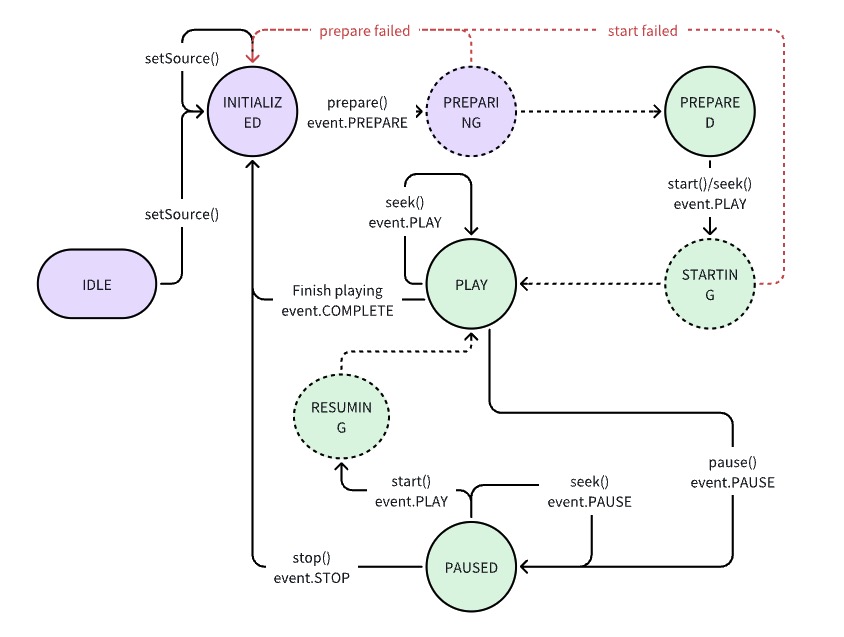
| Event Value | Description |
|---|---|
player.event.PREPARE | prepare() will trigger this event, callback function function(result), result is boolean type, indicating success |
player.event.COMPLETE | After audio starts playing normally, when the audio file or audio data playback ends, you can listen to the COMPLETE event |
player.event.PLAY | start() and seek() will trigger this event, callback function function(result), result is boolean type, indicating success |
player.event.STOP | stop() stops playback |
player.event.PAUSE | Playback paused, triggered by calling pause(), or triggered due to system resource conflicts |
player.event.PROGRESS | Updates playback progress (every second) during playback |
player.state
Player state enumeration
| State Value | Description |
|---|---|
player.state.IDLE | Initial state |
player.state.INITIALIZED | State after setSource |
player.state.PREPARING | Intermediate state, after prepare is called, before PREPARED state |
player.state.PREPARED | State after successful prepare |
player.state.STARTED | State after starting playback, deprecated, use PLAY instead |
player.state.STARTING | Intermediate state, starting playback processing |
player.state.PLAY | State after starting playback |
player.state.PAUSED | State when playback is paused |
player.state.STOPPED | State after stopping playback |
player.state.RESUMING | Intermediate state, resuming playback processing, becomes PLAY state after resume |
Player Event and State Transition Diagram
Record Interface
The recorder supports recording audio to files
setFormat
setFormat(codec: number, param: object): void
Refer to codec values for codec
| codec Value | Description |
|---|---|
codec.OPUS | Opus encoding type |
param type
| Property | Description | Required | Type |
|---|---|---|---|
| target_file | When recording to a file, specify the path to save the audio, supports the mini app's data directory, such as: data://record_file.opus | Yes | string |
Code Examples
// Player
import { create, id } from '@zos/media'

const player = create(id.PLAYER)

player.addEventListener(player.event.PREPARE, function (result) {
  if (result) {
    console.log('=== prepare succeed ===')
    player.start()
  } else {
    console.log('=== prepare fail ===')
  }
})

player.addEventListener(player.event.COMPLETE, function (result) {
  console.log('=== play end ===')
  player.stop()
})

player.setSource(player.source.FILE, { file: '08-15s-16000-1ch.opus' })

// User control
player.prepare()
player.pause()
player.stop()
// Recorder
import { create, id, codec } from '@zos/media'

const recorder = create(id.RECORDER)

recorder.setFormat(codec.OPUS, {
  target_file: 'data://record_file.opus'
})

// start
recorder.start()

// stop
recorder.stop()